
Padraig Harrington
Coding a Sporting Icon.
PROLOGUE - JEANS - THE GREAT DEBATE, WRANGLER or LEVI?
I have been following the progress of Conor Purcell and was delighted to see he has just won the Australian amateur championship. Still, you would be forgiven for thinking, well, what would you expect? His father Joey was a renowned professional for many years and "sure he's just a chip off the old block." Conor would have spent many hours out in Portmarnock practicing, he had a ready-made coach in his father, and he has the life circumstances to be in Australia playing competitive golf in January. This got me thinking about my brother, Padraig, and how he has arrived at three major championships and the Ryder Cup captaincy. This leaves us with many fascinating questions such as What makes us who we are? Can we code a Sporting Icon? Is it just pure luck, or is it a combination of factors?
Part 1 - GENES.
"Genes are inherited traits encoded into a persons DNA."
I sought out some help in this area from a client/friend of mine who just happens to be an expert in genomic technology, Professor Peter O'Gorman.He confirms my research into this very complex subject. Genes are inherited from your parents; 50 % of your DNA comes from each parent. So, it is indisputable that who you are is heavily influenced by your parents. If you don't get the right genes, you will not be a world-class basketball player. Period. There are no five-foot-tall players in the NBA. Similarly, if you don't possess many fast-twitch fibers, then your ability to compete against Usain Bolt is limited!
Golf Trait
So what percentage of who you are is down to genes? The jury is out here, golf is a complex trait, which is defined as a trait that is influenced by many different genetic and environmental factors. The "golf trait" appears to be polygenic, which means multiple genes are involved in determining the trait; there is no one golf gene. Because there are a large number of genes involved in the "making a golf trait," each playing a small role, it is impossible to isolate and identify these genes. Imagine mixing red and blue paint together to make the color purple and then try to separate them again... by hand! This brings us to heritability, which is the amount of variability that is genetic in origin. I can see things that my parents did that reflect on myself and my brothers. My mother was a wizard at counting numbers; my father was a crossword genius; he was also a sporting icon in Gaelic football and was very calm under pressure. He lost in two All Ireland finals and was always very reflective about them, it never upset him that he didn't win, his view was he had played to his best ability, and that is all you can do.
Heritability
I see a lot of my father in Padraig; there is no such thing as a problem that can't be solved. He has surrounded himself with a team that helps him improve every aspect of his golfing life. Padraig, like me, is very analytical and structured. We both got this from our parents. So heritability plays a significant part in our make up. When I reflect on my time in Tour school with Padraig, the honest truth is that it was one of the least stress-filled weeks I have ever had. Everything we did was so structured, right down to playing chess every night, we never worried about the rounds or debated what might have gone right or wrong. Looking back now, we just did the same thing every day and even had the luxury of laying up on the last hole to avoid a risky shot over water, to eventually finish 14th, and the rest is history.
Part 2 - ENVIRONMENTAL CIRCUMSTANCES
There is no doubt that your environmental circumstances play a massive part in how you will turn out. Whatever about trying to second guess how our genes are turned on and off, Padraig's upbringing was a picture postcardof how you would imagine a sportsperson is nurtured. He had four older brothers, so he was exposed to role models. Three of them and his father plus his uncle were all very good at golf, so he always had a goal to chase, and we made sure to remind him!. My father built a golf course, so he had a ready-made environment to thrive at golf. He literally lived in that place, so from a young age, his golf gene was aroused. He could never beat us until he reached the age of 15, so he was always chasing something; this was a familiar pattern later on in his amateur career. It took him an awfully long time to become number one on the Irish amateur circuit, so yet again, he could never relax; he had peers to chase now, always another mountain to climb.
Walker Cup
A good example of this would be the Walker Cup team of 1993 at Interlachen, Padraig had at least six or seven players ahead of him on that team. Interestingly, he is the only person to have excelled from that team of twelve superstars! He experienced a lot of losses early on (mostly self-inflicted) as he came up through the ranks of Irish golf. He had a full-time caddy who was extremely hard on him and a father who was measured and calm. These losses have stood him well over time, this goes back to Dr.Carol Dweck's "Errorful Learning" theory, we learn best through making errors, figuring out what went wrong, fix it and the cycle continues. You become bulletproof through experiential learning.
10,000 hour rule
Malcolm Gladwell has written a number of interesting books on the subject of outliers, people who have achieved extraordinary feats when circumstances suggest otherwise. But a common theme in the success of these outliers is repetition, doing small things day in and day out produces some unbelievable results. The 10,000 hour rule (which is just a phrase) came into play for Padraig growing up, when he eventually settled on playing golf full time at age 15, (he had been exposed to and enjoyed multiple team sports growing up,) he took this 10K rule and I would guess you could multiply it such was the amount of time, effort and energy he put into his golf.
Plasticity.
The brain changes over time due to a process known as plasticity. This continual practice, day in and day out, in an environment of constant flux (things are always changing in golf), with role models and peers to be hunted down, created a snowball effect, looking back on it now, it was like putting jet fuel on a fire, which still burns brightly 30 years later.
Probably the most famous rock band ever, "The Beetles," spent years playing every night in seedy joints in Germany to perfect their style. They just didn't turn up as superstars! The "I am going to be a Rockstar" gene was turned on, they were exposed to practice and repetition, and they evolved. Same for Padraig, his golf genes were switched on, he was exposed to the perfect storm of learning, and he evolved from the 15-year-old child that cried when he lost the final of the Connaught Boys Championship, (I didn't feel great either, to be honest!) to the silent assassin he is today. Looks like a nice guy, but I wish you luck trying to beat him. This brings us again neatly to the third, and for me, the most important part of the equation, what's in your soul?
Part 3 - INNATE DESIRE & WILL.
There is no doubt that many people have the genes to be a sports person, musician, writer, etc but never use them, even when exposed to the right stimuli and this leads us to the great imponderable, your innate will, and desire, or as Angela Duckworth likes to say in her groundbreaking book, "Grit". Why do some people succeed against all the odds, and others fail with everything seemingly in place to succeed? The great philosopher, Plato, had a theory called innate ideas, and the simplified version of what he believed was that innate ideas are concepts that are present in our minds at birth.
Senses and forms
People are made up of what he called senses and forms. Senses are things we learn from experience, and Forms are things that just are! So, this brings us to innate versus learned behaviors. Willpower is defined as conscious self-regulation. I believe that it can be learned to some extent, but with a hat tip to our friend Plato, I do also feel that along with your genes, some people just have that inner drive to bend the universe to their will. Angela Duckworth will argue that self-control, self-discipline, desire, resolve, and grit are all traits that can be learned, but when you continually witness someone putting under the clubhouse lights while everyone is inside enjoying themselves, you wonder what part of the soul they have entered. Padraig was still smiling when we would give him a lift home after his night time putting sessions; it wasn't a chore, he had found his why, his purpose in life, motivation can wander, purpose by definition is a rock-solid concept that never waversWas he lucky?
And that is why Padraig is where he is today, clutching a first-class ticket to Wisconsin and three Major trophies to stare at on his breakfast counter every day. He was handed a bar of gold, and he has spent forty years polishing it. Was he lucky? I don't think so, I witnessed first hand how hard he worked, and I am a great believer in hard work will conquer all. Is it possible to code a sporting icon? probably not, but without work and repetition, all the genes in the world won't get you to the Elysian Fields.
EPILOGUE
It was a sharp and bright day that Sunday at Carnoustie, typical Scottish weather for the links as Padraig stood over the shot that changed his life. He had played flawlessly for seventeen holes and had lapped the field, as others wilted in the furnace-like fires of a winning a Major, Padraig had serenely brought one of the toughest golf courses on planet Earth to its knees, covering those seventeen holes in six under par. An incredible achievement to win your first Major in style. But fate had a final hand to play as he found water twice coming down 18 and now stood over a delicate pitch across a burn he had already found with aplomb. As he hit the pitch, the legendary commentator, Peter Allis, in those dulcet tones, remarked, "he has hit it too hard." But years of "the joy of work" held firm as the ball skidded to a halt four feet from the hole. Once that putt dropped, there was only ever going to be one winner of that Open Championship.
Fate.
Fate played its trump card early, and when Padraig responded, it was a done deal. How do champions summon greatness from the depths of despair? Padraig admitted afterward that he "wanted the ground to swallow him up" as he strode down the 18th that day. Yet he played what he now readily admits to being his greatest ever shot under pressure. There is no gene for this; there are no circumstances to help you here, it is a combination of all three components coming together to produce an ace of spades when fate has played an ace of hearts.
Genes + environment + innate will = sporting icon, and without a doubt, Padraig Harrington is a sporting icon.
An hour to spare?
Podcast Corner!
This weeks Podcast has the man of the moment, Padraig Harrington in a very indepth interview. Very interesting and thought provoking!
It comes from Richard Kaufman, of "The Round Golf Podcast" whom I hadn't come across before but is excellent.

Enjoy!

Last Word -
Padraig Harrington
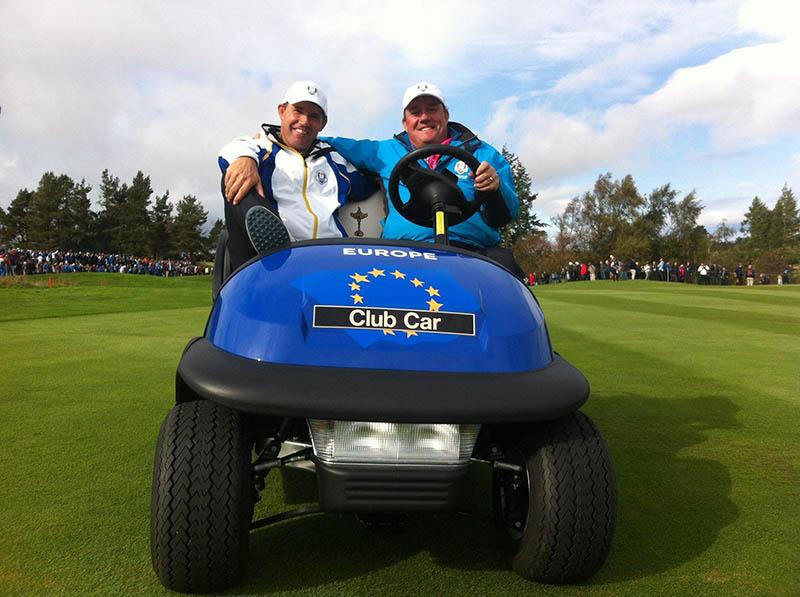
Padraig & Fergal Harrington
“Sergio got a pick this time but I’d be desperate that he plays well enough or gets the pick next time because he does such a great job in that team room.”
Padraig Harrington
You can track and support Padraig's progress over the next twenty months on our dedicated Ryder Cup page here, and you can also subscibe to our free monthly digital magazine here with a chance to win a dozen Pro V1's each & every month!
Hope you all are looking forward to a productive golfing year in 2019.
Thanks for reading, it is appreciated!
Tadhg!

Tadhg Harrington is a full time, professional golf instructor, and owner of the Harrington Golf Academy, based in Dublin, Ireland. He is a graduate of the Titleist Performance Institute and Setanta College. He is the eldest brother of three-time time Major Champion, Padraig Harrington.
He succeeds, employing empathy, passion and exceptional customer service, teaching above the noise, the quick tips, and the latest fads and is truly unique in the Irish golf industry.
The Harrington Golf Academy provides long term coaching programs designed to bring sensory processing to motor learning skills. Tadhg teaches the long game at Drynam Park Golf Centre and short game at Roganstown GC. His business partner, Ex European Tour Player, Rebecca Codd, also teaches full time at Drynam Park Golf Centre.