

The five year anniversary of the Harrington Golf Academy
As the Harrington Golf Academy celebrates it's five year anniversary, a couple of things strike me in terms of goal setting and building a business in today's increasingly digital age. The first thought, without a shadow of a doubt, is, where did the five years go? It is amazing how many people overestimate what they can achieve in a year but way underestimates what they could achieve in a five to ten year period. I have touched upon this before, but it is worth reinforcing. Most people give up way too early when trying to build a business and anyone who is in the golf business industry will also tell you what a tough market it is to break into. I have received many kind emails in the last few days congratulating myself and Rebecca but one overwhelming theme is how did we become so successful in such a short space of time? Well, the answer is, five years is not a short space of time, and it is through the constant compounding of doing the small things correctly every day that delivers huge results. To be honest, my digital plans for the next five years dwarf anything achieved so far! So, if you are reading this and thinking of starting out teaching golf or whatever, here is my present to you. On the back of a notepad! This goal setting plan that I will explain to you in detail is foolproof and bulletproof. The Harrington Golf Academy is a testament to that. It is a variation on the usual 5-year plan, but the figures fit nicely into each other as we will attempt to reverse engineer your long term business goal into bite-size pieces! Invest in a whiteboard, it will keep you honest!
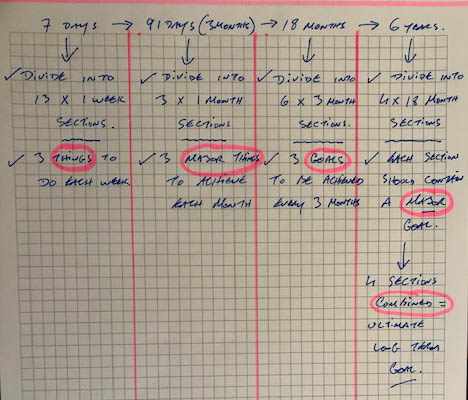
First up, what is your long term goal, where would you like to see your business in 6 years time? Make it a big goal, not unrealistic but a big ask! Write this goal down at the end of your whiteboard. Next up, go to column four, named 6 years, (see attached work of art! Banksy is safe!) Divide it into four 18 month sections and in each section write down what you think you will have needed to achieve so that when you add all four up in six years time they will produce your long term goal. You can add things in and take things out as you go along, just try and make sure they align with the end long term goal.
Next, the third column named 18 months. Divide it into six sections, again fill in what you think you will need to achieve every 3 months (91 days) to further your 18-month goal. Now, second column, 91 days (3 months), Divide it up into three one month sections, the same type of goals as before but to be completed in one month and finally, every Sunday evening go to column one which is divided into 13 seven day sections (91 days!), write down the three most important things you need to do that week to get you on the ladder to success. Now if you blog or do video tips or do a tutorial, then that counts as one thing. So an example here would be, (1) I need to learn how to make a better video for teaching or advertising. (by the way, there is a cosmic world out there in regarding iPhone video!) So, one of your three tasks would be to complete a course in say iPhone video. If it takes more than a week, just add it into week 2 until complete. (2) I need to start the Trackman University course and (3) I need to start to learn marketing. So, they would be all good things to help you grow your business going forward. Now, pick out the courses you are going to do, work out a realistic timeframe to complete them and place in the appropriate timeframe column. Then work backward to make that goal happen. That's it, really simple. If you can crush those three things every week (leave out holidays) and they are in line with your ultimate goal, then you will succeed. Period.
An example to demonstrate the power of compounding, doing small things every day (1% a day) to achieve large goals. You decide you are going to do the "Ironman" in Hawaii. This would be frankly unattainable in most peoples world. A 2.4 mile sea swim, 112 mile bike ride and a marathon to finish! Not happening. So you place Ironman in the 6-year goal. Now work backward, three of the four 18 month goals would have to be (1) cycle a bike for over 100 miles (b) 2-mile plus sea swim and (c) run a marathon. Again, work backward. So, your three things to do in a week might be walking or jogging depending on your fitness levels, cycle a bike for a mile and take swimming lessons. This actually happened to an overweight lady in the States, her first week was WALK for one mile. She struggled to finish walking, within weeks she was jogging and has not only completed the "Ironman" but also has completed multiple marathons. (it took her four years to complete her first marathon!) As you stand there looking up at that large mountain with a teaspoon in your hand, look down and start digging, one day at a time! Delaying instant-gratification is one of the hardest traits to accomplish. We are not hard-wired for it, but if you take this approach, anything is achievable.
Now a health warning here as you start to mark out your different goals in the different sections. Things will change, take it from someone who was rather unceremoniously dumped from two teaching establishments before finally settling at Drynam Park Golf Centre and Roganstown Golf Club. Things will change and this is the beauty of this plan, you can adjust it as you go along, nothing is set in stone, you can adapt as situations arise and update your goals. Hope this helps, it does work, believe me!
Swing Myths!

Swing Myths this week is interesting in that I am constantly amazed when teaching at how clients perceive their swings. It is a regular occurrence to see clients swing high, long and around themselves in an attempt to hit the ball further. This is the exact opposite of what most golfers I see should do. We are bombarded with images of Dustin Johnson and Rory McIlroy which fool us into thinking this is the backswing position we need to achieve as they both hit the ball a country mile! But they are exceptional athletes who spend hours in the gym working on rotation and stability patterns. Most normal golfers would struggle to rotate properly beyond shoulder high. A simple tip for you at home is, get someone to video you swinging from down the line.
Now, at address, draw a line across the top of your head (there are plenty of free golf apps out there for this), take the club to the top of the backswing, has your head moved above (or below) the line? I am talking about 3 to 4 inches? If so, you have a problem, if it is above the line, you are lifting the club as your range of motion (rotation) limits you, if it is moving below the line, you are dipping forward, which if you are a fan of Isaac Newton, you will have to stand back up in your posture to get to the ball at impact. If you have this problem, get it sorted before taking lessons. Any good TPI fitness pro will be able to help you get some extra rotation and you will enjoy the game more!
An hour to spare?
Podcast Corner!
This weeks Podcast comes from "The Cut" the BBC golf podcast presented by the always excellent, Andrew Cotter. He has a number of guests on including Lee Westwood. Highly recommended!

Enjoy!

Thank you for taking the time to read! It is appreciated, we have a number of changes lined up for 2019 with a brand new design for the blog page and some new features. Don't forget to sign up below for my FREE monthly digital magazine (January issue now out!) plus a Kindle book for Xmas and a chance to win a dozen Titleist Pro V1's each & every month.
Tadhg

Tadhg Harrington is a full time, professional golf instructor, and owner of the Harrington Golf Academy, based in Dublin, Ireland. He is a graduate of the Titleist Performance Institute and Setanta College. He is the eldest brother of three-time time Major Champion, Padraig Harrington.
He succeeds, employing empathy, passion and exceptional customer service, teaching above the noise, the quick tips, and the latest fads and is truly unique in the Irish golf industry.
The Harrington Golf Academy provides long term coaching programs designed to bring sensory processing to motor learning skills. Tadhg teaches the long game at Drynam Park Golf Centre and short game at Roganstown GC. His business partner, Ex European Tour Player, Rebecca Codd, also teaches full time at Drynam Park Golf Centre.